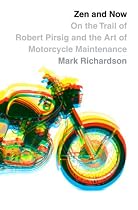
Zen and Now: On the Trail of Robert Pirsig and the Art of Motorcycle Maintenance
Zen and Now is a vivid chronicle of a journalist’s heartfelt and determined journey to reconnect with a beloved American classic.
In 1968, Robert Pirsig and his eleven-year-old son, Chris, made the cross-country motorcycle trip that would become the inspiration for Pirsig’s book Zen and the Art of Motorcycle Maintenance, a powerful blend of personal narrative and philosophical investigation that has inspired generations.
Among the millions of readers to fall under the book’s spell was Mark Richardson, who as a young man struggled to understand Pirsig’s provocative and elusive ideas. Rereading the book decades later, Richardson, now a journalist and a father of two, was moved by its portrayal of Pirsig’s complex relationship with Chris and struck by the timelessness of its lessons. So he tuned up his old Suzuki dirt bike and became a “Pirsig pilgrim,” one of the legion of fans who retrace the Pirsigs’ route from Minneapolis to San Francisco. In following this itinerary over the lonely byways of the American West, Richardson revisits the people and places from Zen and the Art of Motorcycle Maintenance, pondering the meaning of Pirsig’s philosophy and the answers it may offer to the questions in his own life. Richardson’s dogged reporting also gives new insight into the reclusive writer’s life, exploring Pirsig’s struggle with mental illness, his unwanted celebrity, and the tragic, brutal murder of Chris in 1979.
Published to coincide with the fortieth anniversary of Pirsig’s original trip, Zen and Now is a stirring meditation on a classic work and a passionate inquiry into the lessons it continues to teach us in the complex and bewildering world we inhabit today.
Product Details
Editorial Reviews
Review
Praise for Mark Richardson’s Zen and Now:
“Zen and Now serves as a primer for both long-time devotees and newcomers to the Pirsig cult. It is also a harrowing account of the toll that the making of one man’s masterpiece exacted not only on himself but on those around him. . . . The appeal of Pirsig’s message–to make good time ‘with the emphasis on “good” rather than “time,”‘–seems to reverberate still. . . . Zen and Now is a reminder of how much pain it can take to make so many people feel better.” –Eddie Dean, The Wall Street Journal
“Assured and poetic. . . . A sort of Cliff’s Notes version of the dense original, and as much of a biography of Pirsig as Richardson was able to piece together. . . . An enjoyable read. . . . Richardson is quite meticulous in describing the thoughts, sensations, even the superstitions many motorcyclists experience while riding.” –Susan Carpenter, The Los Angeles Times
“Richardson’s strong narrative thread results in a page-turner that does right by the original. Zen and Now is sure to inspire a new generation of riders and readers to pick up Pirsig’s book and take to the open road in search of quality.” –Vince Darcangelo, Rocky Mountain News
“Fans of Pirsig’s cult classic should read Richardson’s book if they want the true story of the author. . . . Richardson digs deep to unearth the motives behind his tormented mentor’s search for quality while embarking on a search of his own. . . . [Zen and Now is] an engrossing tale recounted with a journalist’s attention to fact and an adventurer’s appetite for the enlightening surprise.” —Scott Driscoll, Seattle Post-Intelligencer
“Most notably for fans of the original, Zen and Now pushes the story forward, through Richardson’s correspondence with the interview-averse Pirsig, his editor, his ex-wife, and a second son, Ted, who has disavowed his relationship with his intense father.” –James Sullivan, The Boston Globe
“A good read. . . . Although Richardson is on the trail of Pirsig, this book is as much about his own status in the universe and who he is as a father and a human being. It is charmingly written, honest to a fault and as unpretentious as Pirsig’s book was the opposite. Zen and Now invites the reader along on several levels; Richardson’s research into Pirsig and his life is impeccable and the book is full of all kinds of interesting little nuggets.” –Ted Laturnus, Toronto Globe and Mail
“Zen and Now is a story worth telling, about a journey worth sharing–an entertaining, inspiring, and rewarding read.” –Neil Peart, bestselling author of Ghost Rider: Travels on the Healing Road
About the Author
Mark Richardson is a motorcycle and auto editor and writer for the Toronto Star.
Excerpt. © Reprinted by permission. All rights reserved.
Minnesota
I can tell from the sign by the bank, without turning my head from the road, that it’s nine thirty in the morning. The sign flashes to show it’s 80 degrees, and the heat’s already coming through my jacket. It’s going to be hot today. That’s okay—on a motorcycle, heat is always welcome.
The small town passes, and I’m back among the fields. The bike’s running well this morning, and both of us are stretching out a little, starting to relax on the road now that this trip’s finally under way. You’ll have to excuse me if I think of her sometimes as if she’s a person. It’s just me now, me and my old bike.
I’m on Highway 55, the original road that runs up from Minneapolis toward Minnesota’s northwest. This is an old road, made from concrete with flattened stones in the mix for hardness and ridges every few dozen feet that set up a clickety-clack sound like a locomotive on its tracks.
There aren’t many cars on this stretch of highway because anybody who’s really trying to get somewhere is on the interstate that runs alongside a couple of miles away. Sit on the inter- state and you don’t need to stop till you run out of gas. In fact, on the interstate, if you didn’t have to pull over every few hours and pay at the pump, there’d be no reason to ever slow down or even speak to anyone. Truckers do it all the time. Stay awake for long enough and you’ll be at the coast by Wednesday.
Not on this road, though. Trucks stay off this road. Clickety-clack. There’s been a track here for centuries, paved sometime in the 1920s or ’30s to better link farmers with their markets, Bible salesmen with their customers, children with their schools. This is the kind of road on which life happens, connecting other roads and streets and driveways and communities, not a thruway that picks you up here and throws you off there. It meanders around properties and makes way for the marshes that breed the ducks and red-winged blackbirds that take flight as I ride past. Clickety-clack.
The only way to truly experience a road like this is to be out in the open—not shut up in a car but riding along on top of it on a motorcycle. It’s tough to explain to someone who’s only ever traveled behind a windshield, sealed in with the comforting thunk of a closing door. On a bike there’s no comforting thunk. The road is right there below you, blurring past your feet, ready to scuff your sole should you pull your boot from the peg and let it touch the ground. The wind is all around you and through you while the sun warms your clothing and your face. Take your left hand from the handlebar and place it in the breeze, and it rises and falls with the slipstream as if it were a bird’s wing. Breathe in and smell the new-mown grass. Laugh out loud and your voice gets carried away on the wind.
At least that’s how it is on a warm, sunny day like this Monday morning. Some rain a couple of days ago was a struggle, but I won’t think about that now. There’ll be plenty of time for that later.
Clickety-clack. Somewhere beside the road near here should be a rest area with an iron water pump. Nearly four decades ago a couple of motorcycles stopped here, and their riders took a cool drink from the pump. Should be coming up on the left and—here it is. Just like in the book. This road really hasn’t changed much at all.
There’s a place to park the bike near some picnic tables under a shelter, and the grass drops down to a stream behind the trees. To one side is the iron hand pump that’s mentioned in the book. It still draws cool water. The spout is opposite the pump, so I have to dash around with my hands cupped to catch the gushing water. I capture just a trickle—I have no proper cup. The Zen riders would have brought a cup. Besides, there were four of them—enough for one to pump and another to drink. I’m on my own today.
Those Zen riders—they’re why I’m here. Robert Pirsig and his eleven-year-old son, Chris, on Pirsig’s old 28-horsepower, 305-cc Honda Superhawk CB77, and Pirsig’s friends John and Sylvia Sutherland on their new BMW R60/2. They were making a long summer ride back in 1968, and then Pirsig went and wrote about it and his book became a best seller. Zen and the Art of Motorcycle Maintenance is still in bookstores, and of the five million copies sold, two are in my saddlebags.
One of those two books is an early edition, liberated from the bookshelf in my aunt’s living room years ago because it had a picture of a motorcycle on its pink cover; the other is the twenty-fifth-anniversary edition, larger and a little revised. And now here, at the first stop mentioned in the book, it’s the pink edition I pull out and read awhile, lying back on the grass.
I’ve always been curious about this book, although it took years for me to read it all the way through. I pulled it from that bookshelf one quiet afternoon, settled on the sofa, and was captivated by its first pages, by the evocative description of these ponds and marshes and the riders’ gentle progress. It tells the story of a man and his son, ostensibly Pirsig and Chris, on a vacation trip to San Francisco by motorcycle from their home in the twin cities of Minneapolis/St. Paul. This is the framework for a multilayered, intricately structured narrative that is far more about their personal struggles with inner demons than it is about getting to the coast. It’s also the platform from which Pirsig explores and explains his philosophy. Only a few pages in, the narrator wanders from his road trip to lament the lack of quality in his modern-day America, and that’s when my teenage attention tuned out. I took the book home anyway. There was something about that illustration on the back cover—a guy standing with his son, beside a motorcycle, looking away to the horizon.
A dozen years later, halfway through Philosophy 101 and getting nowhere, I found the book again and gave it another try. Reading slowly but steadily, I made it to the mountains of Montana before the term ended and other courses overwhelmed me. Something had clicked, though. Maybe it was Pirsig’s luggage list, his rhyming off of the same sweaters and gloves and rain gear that I’d grown accustomed to packing for frantic weekend trips to the mountains on my sport bike. More likely it was the items on the list that made us different: rope when I carried bungee cords; goggles instead of a full-face helmet; a cold chisel, a taper punch, and point files for those mysterious workings inside the bike’s engine, when I carried just a pair of Vise-Grips. Both of us were looking for the same thing from our travels, just using different tools.
It wasn’t until last summer that I picked up the book for a third time, looking for something to read on the first vacation in five years during which I could relax from some of the responsibilities of parenthood. That time, reading with a whole new perspective, I sailed right through. The guy got it! He wasn’t just looking for a nice vacation; he wanted to figure out “quality” as a thing in itself, not just a description—a noun, not an adjective. He wanted to learn what’s needed for his life—my life, everyone’s life—to move up a notch, to be the best it can be, truly harmonious in a world swamped by so many improvements that they buckle under the weight of their time-saving intentions. For me, as a busy parent juggling work with family, that perspective struck close to home.
But it’s showing its age, this book. It’s written in a folksy style that reminds me of my parents, and it refers constantly to the paraphenalia of a previous generation. Just a few pages in, reading now on the warm grass of the travelers’ pause at this exact place, I come to Pirsig’s description of Sutherland going through his luggage here and finding a pair of shoelaces and their joking about his overpacked bike. Shoelaces! These days, in 2004, my kids don’t even know how to tie shoelaces—their footwear uses Velcro.
If I want to update the journey, I must find out more about the people who forged it and follow their tire tracks for myself. The ultimate truth about the world is biography, wrote Pirsig much later, and while my tools will be different, the reward could still be great. Perhaps some of its lessons will rub off along the way.
Beyond the rest area the road is straight and predictable, rising and dipping through fields and swamps, bordered by blue and yellow wildflowers in the uncut verge. Every small pool I pass seems to have a heron at one end, eyeing the fish or the frogs and waiting to see which of them can stay more still, and ducks at the other end, paddling softly around the shoreline’s reeds. Such slow and lazy movement, while on the road itself the concrete stretches on and on, clickety-clack, as I ride steadily northwest and the hot sun slips across the sky.
At the side of the road up ahead there’s a dead animal, well picked over by predators and no longer recognizable for whatever it used to be. The road may be hot and sultry, but it is not kind. It’s hard and noisy and can kill anything in a blink if it’s not understood and treated with respect.
Back in Wisconsin a couple of days ago, riding to Minneapolis to start this journey, I passed through a national forest, and there, lying beside the road, was a bald eagle, huge and glassy eyed, its neck twisted. The bird’s feathers were scattered across the lane—a vehicle must have struck it as it swooped down for prey. I rode past, then doubled back and looked more closely, peering into its unseeing eyes and studying its sharp talons and perfect beak. Even in death it was intimidating.
A few mi...
Customer Reviews
Finally, an Interviewer Shares insights on Pirsig's First Family
Unlike several of the other Amazon reviewers, when I read "Zen and Now" I found that Richardson understands that "Zen and the Art" was about much more than a motorcycle trip. However, he felt that it would be pointless for a third party to recreate Robert Pirsig's bestseller. What Richardson does do is to fill in many gaps in our understanding of Pirsig himself. In other words, this is literary biography. And, as literary biography, I give this book high marks.
What's new about "Zen and Now"? Until now, how many readers knew that Pirsig had two sons? In Richardson's text we learn about Ted Pirsig, the son (close to Chris Pirsig's age)whom Robert Pirsig never mentions in his writings or interviews. Why is that? And why does his son, Ted, refer to him as his "ex-father"? We also learn about the mother of Ted and Chris, Nancy James, a gracious hostess and creator of a wonderful restaurant in Minneapolis, an active member of the Zen Center on Lake Calhoun. She was the woman in the shadows who looked after Robert when his mental breakdown pushed him close to edge. "Zen and the Art of Motorcycle Maintenance" would never have been written if she had not cared for him and held the family together during his breakdown.
In an interview with Richardson, Nancy James presents a legitimate counterpoint to Robert Pirsig's assertion that she and Pirsig's father, Maynard, were cruel to force him into mental health care that destroyed "the genius with the 170 I. Q." If they thought that the author was a danger to himself and others how could they not intervene?
We Westerners, myself included, tend to put Zen Buddhism on a pedestal where it is safe from rational criticism. However, Nancy James shows us what it is like to be told that her thoughts and instincts lack "value" because she has not achieved enlightenment like her esteemed partner.
Furthermore, I've never understood how readers can brush off the fact that Chris Pirsig was in tears for most of trip. His vantage point was blocked by his father's back. (I would have like Richardson to tell us more about Chris's long struggle with mental illness after the trip as he does with Ted.) As a parent,I see Pirsig's treatment of his son as callous. In other words, as Robert Pirsig himself might concede, "the great man has feet of clay." Like many of the great men we idolize, Pirsig is imperfect. He searches for "quality" and the "good" because he sees that it is lacking in parts of his own life.
In the "bad old days," readers were taught to ignore the context in which great works of art were created. Thank goodness those days are over. "Quality" and "Good" can be examined in a humanitarian context as well.
zen and ho-hum
i kick-started this book with high hopes and expectations, if only to reconnect with the original zamm which i read as a college freshman at the university of michigan in 1976. but disappointment soon came over me, as i realized that the author was more intent on making "time" than "seeing" america as he attempted to retrace pirsig's original route. didn't he know that you can't step in the same river twice? and why was he so intent on making it to sf by his 42nd birthday? to his credit, the good parts of the book are like scenic overlooks into the biography of pirsig himself, and the tortuous psychological journey that became his life. pirsig gave the world a great book, and like prometheus, suffered for it. you need to be a real zamm devotee to want to buy and read this shallow retread. i am sure that it made a nifty and clever book proposal, but too much of the book is dull and lacks genuine introspection by not searching for higher, deeper philosophical truths. instead, the author is more concerned about writing in too much detail about all the various motels he stayed in. for that, one can buy an aaa motel guide.
Interesting, although not very deep
It was enjoyable reading up on some of the characters behind the ZAMM story. But there's too much fluff here.
Related Links : Product by Amazon or shopping-lifestyle-20 Store

ไม่มีความคิดเห็น:
แสดงความคิดเห็น