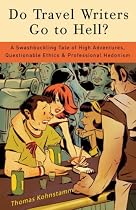
Do Travel Writers Go to Hell?: A Swashbuckling Tale of High Adventures, Questionable Ethics, and Professional Hedonism
For those who think that travel guidebooks are the gospel truth.The waitress suggests that I come back after she closes down the restaurant, around midnight. We end up having sex in a chair and then on one of the tables in the back corner. I pen a note in my Moleskine that I will later recount in the guidebook review, saying that the restaurant “is a pleasant surprise . . . and the table service is friendly.” –Thomas Kohnstamm, professional travel writer and author of numerous Lonely Planet guidebooks
WANTED: Travel Writer for Brazil
QUALIFICATIONS REQUIRED
Decisiveness: the ability to desert your entire previous life–including well-salaried office job, attractive girlfriend, and basic sanity for less than minimum wage
Attention to detail: the skill to research northeastern Brazil, including transportation, restaurants, hotels, culture, customs, and language, while juggling sleep deprivation, nonstop nightlife, and excessive alcohol consumption
Creativity: the imagination to write about places you never actually visit
Resourcefulness: utilizing persuasion, seduction, and threats, when necessary, to secure a place to stay for the evening once your pitiable advance has been (mis)spent
Resilience: determination to overcome setbacks such as bankruptcy, disillusionment, and an ill-fated one-night stand with an Austrian flight attendant
As Kohnstamm comes to personal terms with each of these job requirements, he unveils the underside of the travel industry and its often-harrowing effect on writers, travelers, and the destinations themselves. Moreover, he invites us into his world of compromising and scandalous situations in one of the most exciting countries as he races against an impossible deadline.
Product Details
Editorial Reviews
Review
"A comic rogue who seems to have modeled his life and prose on Hunter S. Thompson’s… I could not get enough of the most depraved travel book of the year."
—The New York Times
"Hilarious"
—The New York Times Book Review
"the shot heard 'round the travel world…"
—The Washington Post
"A guidebook writer reveals the truth about his trade, in detail that will shock and awe."
—Outside
"It’s Upton Sinclair’s The Jungle, but with tourism"
—The New York Observer
"Kohnstamm is nobody's model travel journalist, except maybe Hunter Thompson's… [he’s the] sudden enfant terrible of his field… Do Travel Writers Go To Hell? is the best-written, funniest book of travel literature since Phaic Tan."
—The Philadelphia Inquirer
"Sharp writing and self-deprecating wit add spice to a chronicle of the sometimes absurd world of guidebook writing."
—Booklist
"Readers will relish the countless stories of the author's misadventures, but Kohnstamm brings more than just anecdotes: He offers a solid understanding of the mechanics of the travel-writing industry and a unique ability to illuminate that world to readers. Notable for its spirited prose and insightful exploration of the less-romantic side of travel writing. Kohnstamm is one to watch."
—Kirkus Reviews (starred review)
About the Author
THOMAS KOHNSTAMM was born in 1975 and graduated from Stanford University with an M.A. in Latin American studies. He lives in Seattle.
Excerpt. © Reprinted by permission. All rights reserved.
1
One in the Hand, Two in the Bush
Roebling.
Roe-bleeeng.
Rrrrroe-bling.
Alone in the fifty-seventh-floor conference room, I repeat the mantra under my breath. I sit in a rigid half-lotus position atop the glass table and watch the suspension cables of the Brooklyn Bridge flicker against the night sky. The office air is sharp with disinfectant. I take a slug of rum and return to my mantra.
John Roebling had a calling. Unfortunately for him, after the buildup, design, preparation, and politicking for the construction of the Brooklyn Bridge, the hapless bastard promptly dropped dead. His son, Washington, brought the bridge to completion, but not without picking up a case of the bends and almost dying in the process. Neither man ever wavered from a life of dedication, direction, and diligence.
A lot of good it did either of them.
I remove my battered leather shoes, the toes stained gray with salt from the slushy city sidewalks, and knead my left foot through my sweaty dress sock. Hundreds of pairs of headlights move in a stream back and forth across the bridge.
Yesterday during a meeting in this same conference room, a neckless, pockmarked banker pointed out that the name the bends was, in fact, coined during the construction of the Brooklyn Bridge. Hundreds of laborers toiled on the footing of the bridge, eighty feet below the surface of the river. They worked in nine-foot-high wooden boxes known as caissons, which were pumped full of compressed air and lowered to the depths with the men inside. After resurfacing, scores of workers were inflicted with a mysterious illness. Crippling joint pain. Mental deterioration. Paralysis. And for a few, agonizing death. The name the bends was taken from the debilitated posture of the sufferers.
It wasn't until eight years after the bridge construction had started that a French physiologist determined the cause of the illness. Contrary to popular assumption, oxygen is a lesser ingredient in the air that we breathe. Seventy-eight percent of air is comprised of nitrogen, which, under normal circumstances, has no effect on the human body. When breathing air at depth, the water pressure converts the nitrogen in the bloodstream from a gas to a liquid, washing it through the veins and arteries. So long as you resurface at a slow pace, the liquid gradually transforms back into a gas and is disposed of by your body.
If the change of pressure is too sudden, the liquid bursts out of solution, fizzing back into gas. Similar to the millions of microscopic nitrogen bubbles that are released when you crack a can of Guinness, the bubbles surge through the bloodstream. If they don't lodge themselves in your joints, the bubbles charge on the fatal path to your brain. You come up too quickly, you die.
I remove a folded piece of printer paper from my pocket and smooth it open:
Thomas,
I want to know if you'd like do some writing for our new Brazil guidebook?
If you're interested in jumping ship within the next few weeks for Brazil, let me know right away and I could put together an offer for you.
Commissioning Editor--South America & Antarctica
Lonely Planet
Once--maybe when I was first out of school--this opportunity would have been a dream job. It is still seductive, but more along the lines of a cheap one-night-stand. My life is fulfilling in other ways now. I have a steady job, a decent income, a beautiful girlfriend, and an apartment in Manhattan. I finally have everything that I am supposed to have. Besides, between 9/11, SARS, Iraq, Bali, and Madrid, it can't possibly be a good time to dive headfirst into travel writing. But I won't I lie: I have always been a sucker for a cheap one-night-stand.
God knows, I can already feel myself coming up too fast.
For most people, November 24 is not a special day. Sure, it hosts Thanksgiving every few years, but I could care less about that. In Seattle, where few things out-of-the-ordinary ever happen and where people strive, often pathologically, to maintain a facade of tranquility, the day has a different significance.
On November 24, 1971, a balding, middle-aged man boarded a flight from Portland to Seattle. He used the name Dan Cooper. He dressed in a black suit, a black overcoat, black sunglasses, and a narrow black tie with a pearl stick pin. Cooper hijacked the Boeing 727 with a briefcase full of wires and bright red cylinders. The hostages were exchanged for four parachutes and two hundred thousand dollars at Sea-Tac Airport (to put that in perspective, the average cost of a new home in the U.S. in 1971 was $28,000).
DB Cooper, as the press mistakenly dubbed him, demanded to be flown to Mexico. He parachuted out of the plane somewhere over southern Washington State and disappeared. Maybe DB died in the jump. Maybe he got away with the money. Nobody knows. But legend has it that DB was a man so disenchanted with his life that he gambled it all on a way out. The point isn't whether he made it or not. The point is that this little bald man didn't spend one more day pumping gas in Tallahassee or adjusting claims in Denver. He didn't waste one more day wondering, "What if?"
I nominate Cooper as the patron saint of disillusioned men, particularly those who, like me, were born in Seattle on November 24.
The phone rings in the conference room. It is the blipping staccato ring of all office phones. I am jolted back to the reality that I have hours of work ahead of me. The digital clock on the phone reads 9:42 p.m.
Tucking the pint bottle of rum into the waist of my pants, I answer with a cautious "Hello."
"Thomas? WHAT ARE YOU DOING IN THE CONFERENCE ROOM, DAMMIT. I knew I could find you there. You and I need to have a talk," my boss snarls. "I am coming by your cube in fifteen minutes. You'd better be there, with the WorldCom spreadsheet ready for me to look at."
I tiptoe back into my cubicle, successfully avoiding anyone in the hallways. I hold my head in my hands, shirt sleeves rolled up, with cold sweat dripping down my sides. My tacky palms are crisscrossed with hairs from my suddenly receding hairline. After the final sip of a metallic-sweet Red Bull, I chew a handful of gum and look across the tops of the cubicles, scanning for other workers. The office appears empty, except for the faint tapping of keyboards somewhere down the hall.
Welcome to life on Wall Street. With such a character-defining foothold in the career world, I no longer have to make excuses for the life I lead. No longer do I have to explain my directionless postcollegiate life to incredulous eyes and repetitive questions, like: "What are you doing next year?" "Don't you want to do something with your life?" and my favorite, "When are you going to get a real job?" I am no longer just Thomas, the supposed slacker, backpacker bum, or permanent student. I am Thomas, the employee of , , & LLP, and I am going places.
I make more money than I reasonably should, putting papers into chronological order (chroning, in office-speak). My skill set also includes entering numbers into Excel spreadsheets and working the copier and fax machine. Between those projects, I search for old high school friends' names on Google; play online Jeopardy against my office trivia nemesis, Jerry; and generally while away the hours of my life. Jerry thinks that he is better at Jeopardy than me, but really he's just faster with the mouse.
Yes, I know, I really have it pretty good. There are people starving in Africa. And there are plenty of people here in New York who would love the chance to be in a cubicle all day and not have to operate deep-fat fryers, drive garbage trucks, suck dicks, or whatever it is they do. The problem is that I am an ungrateful by-product of a prosperous society--the offal of opportunity. I am just another liberal arts graduate who bought the idea that life and career would be a fulfilling intellectual journey. Unfortunately, I am performing a glorified version of punching the time clock, and the financial rewards don't come anywhere near filling the emotional void of such diminished expectations.
But let's face it: rebellion is passe. My parents' generation already proved that--over time--rebellion boils down to little more than Saab ownership and an annual contribution to public radio. The old icons have been co-opted. JoseŽ Mart’ is a brand of mojito mix. Che Guevara is a T-shirt. Cherokees are SUVs, and Apaches are helicopter gunships.
The American Dream is for immigrants. The rest of us are better acquainted with entitlement or boredom than we are with our own survival mechanisms. And when confronted with a fight-or-flight scenario, the latter usually takes precedence. Escape is our action of choice: escape through pharmaceuticals, escape through technology, and plain old running away in search of something else, anything else. I rummage through the back of my desk drawer looking for a loose Vicodin or a Klonopin. The best thing I come up with is Wite-Out, but I'm not that desperate. Yet.
I continually revisit the words of some sociologist who I read in college. I think that it was Weber or Durkheim. Either is usually a fair guess. He believed that the modern mind is determined to expand its repertoire of experiences, and is bent on avoiding any specialization that threatens to interrupt the search for alternatives and novelty. Many people would call that approach to life a crisis, immaturity, or being out of touch with reality. It could also be called the New American Dream...
Customer Reviews
More cachaça please!
Reading this book, I felt like my crazy friend was telling me about his ridiculous time in Brazil.
This is a great book for anyone who wants to know what its like to be bold, travel by yourself! Kohnstamm's book is shocking and real. Did you go with Kohnstamm and party in Brazil? Because after this book you will feel like you have.
I recommend this book for anyone who wants to travel the world. As crazy as the book is, a lot of it is very relatable. My favorite part was how Kohnstamm describes the hostel lifestyle and mini-culture perfectly! All the crazy people he meets, becomes friends with, drinks with. Anyone who has had to pay money to sleep in a hot room with strangers who might steal your stuff and do weird things in the dark can reminisce with Kohnstamm.
An entertaining read
I really enjoyed reading this book. It was very fun to read especially since the author didn't shy away from the nitty gritty realities of his experinces that which were work mixed in with a lot of play.
sounds like a few people I know!
A frank realization of the footfalls us travelers traverse for better or worse to seek adventure. Excellent recount of the hysteria of life on the road and "cheers" to Thomas for having the gumption to lay it all out there.
If you've ever really traveled, you might just have some parallels with this guy! Take it as you will but we all do crazy things. Some of us just go at things with a little more flair!
Related Links : Product by Amazon or shopping-lifestyle-20 Store

ไม่มีความคิดเห็น:
แสดงความคิดเห็น