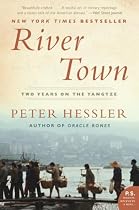
River Town: Two Years on the Yangtze (P.S.)
A New York Times Notable Book
Winner of the Kiriyama Book Prize
In the heart of China's Sichuan province, amid the terraced hills of the Yangtze River valley, lies the remote town of Fuling. Like many other small cities in this ever-evolving country, Fuling is heading down a new path of change and growth, which came into remarkably sharp focus when Peter Hessler arrived as a Peace Corps volunteer, marking the first time in more than half a century that the city had an American resident. Hessler taught English and American literature at the local college, but it was his students who taught him about the complex processes of understanding that take place when one is immersed in a radically different society.
Poignant, thoughtful, funny, and enormously compelling, River Town is an unforgettable portrait of a city that is seeking to understand both what it was and what it someday will be.
Product Details
Editorial Reviews
Amazon.com Review
In 1996, 26-year-old Peter Hessler arrived in Fuling, a town on China's Yangtze River, to begin a two-year Peace Corps stint as a teacher at the local college. Along with fellow teacher Adam Meier, the two are the first foreigners to be in this part of the Sichuan province for 50 years. Expecting a calm couple of years, Hessler at first does not realize the social, cultural, and personal implications of being thrust into a such radically different society. In River Town: Two Years on the Yangtze, Hessler tells of his experience with the citizens of Fuling, the political and historical climate, and the feel of the city itself.
"Few passengers disembark at Fuling ... and so Fuling appears like a break in a dream--the quiet river, the cabins full of travelers drifting off to sleep, the lights of the city rising from the blackness of the Yangtze," says Hessler. A poor city by Chinese standards, the students at the college are mainly from small villages and are considered very lucky to be continuing their education. As an English teacher, Hessler is delighted with his students' fresh reactions to classic literature. One student says of Hamlet, "I don't admire him and I dislike him. I think he is too sensitive and conservative and selfish." Hessler marvels,
You couldn't have said something like that at Oxford. You couldn't simply say: I don't like Hamlet because I think he's a lousy person. Everything had to be more clever than that ... you had to dismantle it ... not just the play itself but everything that had ever been written about it.Over the course of two years, Hessler and Meier learn more they ever guessed about the lives, dreams, and expectations of the Fuling people.
Hessler's writing is lovely. His observations are evocative, insightful, and often poignant--and just as often, funny. It's a pleasure to read of his (mis)adventures. Hessler returned to the U.S. with a new perspective on modern China and its people. After reading River Town, you'll have one, too. --Dana Van Nest
From Publishers Weekly
In China, the year 1997 was marked by two momentous events: the death of Deng Xiaoping, the country's leader for two decades, and the return of Hong Kong after a century and a half of British rule. A young American who spent two years teaching English literature in a small town on the Yangtze, Hessler observed these events through two sets of eyes: his own and those of his alter ego, Ho Wei. Hessler sees China's politics and ceremony with the detachment of a foreigner, noting how grand political events affect the lives of ordinary people. The passing of Deng, for example, provokes a handful of thoughtful and unexpected essays from Hessler's students. The departure of the British from Hong Kong sparks a conversational "Opium War" between him and his nationalist Chinese tutor. Meanwhile, Ho Wei, as Hessler is known to most of the townspeople, adopts a friendly and unsophisticated persona that allows him to learn the language and culture of his surroundings even as Hessler's Western self remains estranged. The author conceives this memoir of his time in China as the collaborative effort of his double identity. "Ho Wei," he writes, "left his notebooks on the desk of Peter Hessler, who typed everything into his computer. The notebooks were the only thing they truly shared." Yet it's clear that, for Hessler, Ho Wei is more than a literary device: to live in China, he felt compelled to subjugate his real identity to a character role. Hessler has already been assured the approval of a select audience thanks to the New Yorker's recent publication of an excerpt. (Feb.)
Copyright 2000 Reed Business Information, Inc.
From Library Journal
This moving, mesmerizing memoir recounts Hessler's two years as a Peace Corps volunteer teaching English in the city of Fuling, located in the heart of China. Before Hessler's arrival, no one in Fuling had seen a foreigner for 50 years. Hessler was rudely thrust into this forbidden land, completely isolated from the world as we know it. Armed with astute powers of observation, acute sensitivity to cultural differences, and a good command of Chinese, he explores the culture, politics, traditions, and ideas of a people completely unknown and mysterious to the Western World. Hessler also watches as the cityDtorn between tradition and the onslaught of modern timesDreacts to the death of Deng Xiaoping, the return of Hong Kong to the mainland, and the inevitable construction of the Three Gorges Dam on its beloved, and sacred, Yangtze River. This touching memoir of an American dropped into the center of China transcends the boundaries of the travel genre and will appeal to anyone wanting to learn more about the heart and soul of the Chinese people. Highly recommended.
-DMelinda Stivers Leach, Precision Editorial Svcs., Wondervu, CO
Copyright 2001 Reed Business Information, Inc.
Customer Reviews
beautifully written
This is a wonderful book. The book follows Peter Hessler through his two years teaching English in a small teaching college in a small town in China. It's interesting to read as Peter gets more and more comfortable with the environment and language. In fact, one of the things that's so special about this book is that the author and location essentially stay the same throughout. The book's movement comes through layering and rediscovery as the author becomes more-and-more familiar with the people, language, and culture. I tend to find books like this (i.e. authors immersed in a new culture) somewhat unsatisfying since I think they often become either comedies with eccentric characters or they become more about self-exploration than anything else. This book has neither of these failings. It's simply an account of the author's experiences, impressions, and limitations as he becomes more-and-more a part of the community. The people are three-dimensional and I felt like I got a little understanding of the culture as I met more-and-more of them and started seeing patterns.
Peter Hessler chronicles growth and change in China (and himself)
China is indeed currently undergoing the largest, fastest modernization and transformation of a major country in human history. The scale of change in all areas (buildings, infrastructure, geography, economics, social, cultural) is vast. Yet the current transformation is but one in a series of major historical changes in the past century, as China has gone from empirical rule through civil war to the expulsion of foreign colonial influences, to the excesses of communism including the Cultural Revolution, to the current transformation, officially called "Reform and Opening".
What does this change look like on the "ground level" of average Chinese citizens, and how do they feel about it? What tensions and conflicts arise as the Chinese people are forced to (again) change their attitudes, behaviors and values? What beliefs and practices persist through the change? What might all this change lead to for these people? These are the questions that interest Peter Hessler, and that he focuses on in "River Town".
After completing graduate studies, Hessler signs up for a two year stint in the Peace Corps, and is assigned to teach English literature to Chinese teachers-in-training at a college in a relatively small, out of the way Yangtze River city. "River Town" chronicles these two years of Hessler's life, as he explores the city, learns Mandarin, and tries to get to know as many different people as possible. I found "River Town" to be a fascinating book, as Hessler does a superb job of describing people's thoughts and actions, and putting them into the greater context of China's politics, culture and the ongoing transformation of the country. The stories Hessler includes are engaging and entertaining, and sometimes funny. Hessler has a real love for the Chinese people (although not for many aspects of the political system), and it shows in his writing.
I read Hessler's second China book ("Oracle Bones") first, and thoroughly enjoyed each. Although it is preferable to read the first book first, I don't feel I missed out on much by reading them in reverse order. If you only have the time or inclination to read one, I recommend "River Town" as the slightly better of the two, but both are highly enjoyable and educational.
China, both Complex and Fascinating
I picked up this book whilst on a business trip in China. It tells the tale of a 26yr old American Graduate (Peter Hessler) heading to rural China for 2yrs to help teach English. His portrayal of China is beautiful, complex and fascinating. You learn a little of how the people are influenced by the communist regime, their lifestyles, attitudes to the western world and of course their inner beauty. You can almost inhale the Chinese environment as he navigates you from industrial China with it's bellowing smog to the natural beauty of the rugged landscapes. Where this book wins for me is it's portrayal of the Chinese people, warm, curious and captivating. If you have a passing interest in Chinese culture, then you should read this. A very easy and enjoyable read.
Related Links : Product by Amazon or shopping-lifestyle-20 Store

ไม่มีความคิดเห็น:
แสดงความคิดเห็น