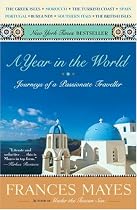
A Year in the World: Journeys of A Passionate Traveller
The author who unforgettably captured the experience of starting a new life in Tuscany in bestselling travel memoirs expands her horizons to immerse herself—and her readers—in the sights, aromas, and treasures of twelve new special places.
A Year in the World is vintage Frances Mayes—a celebration of the allure of travel, of serendipitous pleasures found in unlikely locales, of memory woven into the present, and of a joyous sense of quest. An ideal travel companion, Frances Mayes brings to the page the curiosity of an intrepid explorer, remarkable insights into the wonder of the everyday, and a compelling narrative style that entertains as it informs.
With her beloved Tuscany as a home base, Mayes travels to Spain, Portugal, France, the British Isles, and to the Mediterranean world of Turkey, Greece, the South of Italy, and North Africa. In Andalucía, she relishes the intersection of cultures. She cooks in Portugal, gathers ideas in the gardens of England and Scotland, takes a literary pilgrimage to Burgundy, discovers an ideal place to live in Mantova, and explores the essential Moroccan city of Fez. She rents houses among ordinary residents, shops at neighborhood markets, wanders the back streets, and everywhere contemplates the concept of home. While in Greece, she follows the classic Homeric voyage across the Aegean, lives in a bougainvillea-draped stone house in Crete, and then drives deep into the Mani. In Turkey with friends, she sails the ancient coast, hiking to archaeological sites and snorkeling over sunken Byzantine towns. Weaving together personal perceptions and informed commentary on art, architecture, history, landscape, and social and culinary traditions of each area, Mayes brings the immediacy of life in her temporary homes to the reader. An illuminating and passionate book that will be savored by all who loved Under the Tuscan Sun, A Year in the World is travel writing at its peak.
Product Details
Editorial Reviews
From Publishers Weekly
Even people who don't normally read travel books are aware of the old Italian villa that Mayes and her husband restored, chronicled in Mayes's bestseller Under the Tuscan Sun and three other books about Tuscany. So it's somewhat surprising when Mayes declares her wanderlust, her passion for other beautiful places in the world. She adores Tuscany, but also loves tasting other people's cuisines, learning their gardening habits, reading their poetry, swimming their waters. She's always looking around and wondering, "How do place and character intertwine? Could I feel at home here? What is home to those around me? Who are they in their homes, those mysterious others?" In this luminous volume, she and her husband visit southern Spain, Portugal, Sicily, southern Italy, Morocco, Greece, Crete, Scotland, Turkey and places in between. Usually they rent an apartment or villa, so they can cook, sprawl and feel like "locals." They survive a couple of package trips (a cruise around the Greek islands, a small charter around Turkey) which only highlight the pleasures of independent travel—having the freedom to wander and discover things for themselves, without a schedule. And happily, there's no mention of prices to mar readers' escapist fantasies. (Mar. 14)
Copyright © Reed Business Information, a division of Reed Elsevier Inc. All rights reserved.
From The Washington Post
In this age of adventure travel, the lure of the increasingly exotic holds sway. It's no longer enough for vacationers to take a barge down a French river or browse in an Italian market -- no, one must rappel in Africa, kayak in Nepal. The activities must be rugged, and the locales far from the Western traveler's starting place. Given this, many travel-hounds will eye the mostly European destinations listed in Frances Mayes's table of contents dismissively.
Mayes, author of the best-selling Under the Tuscan Sun plus three more follow-up odes to her adopted home, lives a blessedly split life -- going back and forth between northern California and Cortona, Italy, which provides her Tuscan sunshine. It is from these bases that she and her husband, Ed, venture forth to the places some will find too familiar -- Scotland, the Greek islands, Naples. But paradoxically, it is just this sticking to well-trod ground that is one of the book's strengths. For although much, much, too much has been written of the wonders of Burgundy, the beauties of Capri and the gardens of England, when Mayes is at her best, she proves the point that a good writer, a good traveler, can always come up with new insights.
Yet they are not the insights one would expect from a book with the title A Year in the World, which implies that Mayes actually spent a year out in the world -- traveling, traipsing, exploring. In reality what she did was string together reports on many trips, taken over a five-year period, to form this collection. Perhaps it doesn't really matter whether the trips were taken all at once or sandwiched in and around the minutiae of everyday life. But a year spent unmoored -- from home and errands and work and the ties that bind -- would have yielded a very different sort of book from this. These trips -- house rentals, hotel stays, even a cruise -- represent a series of vacations, instead of the year-long quest that the title promises.
Mayes was a poet and professor before she became a one-woman Tuscan industry. She's well versed in literature and art history, and obviously relishes reading up on the history of any new part of the world she encounters. When her method works well, as in her section on Mantova, Italy, it's enriching; her talk of the painter Mantegna and of Shakespeare (in English, Mantova is Mantua, where Romeo awaits news of Juliet) and of the powerful ruling Gonzaga family adds depth and texture to her narrative. (You find yourself making a mental note to plan a visit to the city and to re-read "Romeo and Juliet" on the way there.) But when it fails, it's just clunky verbiage -- fact after enumerated fact, layered one upon another in endless succession (towers in Istanbul, wildflowers in Greece: the eyes glaze, the attention wanders).
In Mayes's world, the blues are always "intense," the waters always "limpid." But just when you think you can't stand another minute, she saves herself. A chapter on a cruise through the Greek islands starts out unpromisingly with Mayes explaining that this is no romantic sea voyage, but rather an ordinary, all-buffets-all-the-time cruise on which she has been invited as a speaker. Then the section takes off, as she reveals a seldom-seen aspect of her writing: an acerbic wit. Quickly, she sees what she's in for with this style of group travel, so far from her usual Tuscan Sun mode: "This first day off the ship, I see how the trip will be. We may choose one dish from a whole menu, one sip from a great bottle of wine. One monastery, not ten. The sublime Byzantine icon museum, but not the Archaeology Museum. We'll have a glimpse, a taste, a few impressions to memorize, and then we go back on board, flashing our ID cards, and sail on."
Among Mayes's most thought-provoking passages are the ones in which she faces the least Western cultures of her travels: a visit to the city of Fez in Morocco and another cruise (of a very different sort) in a traditional wooden gulet along Turkey's Lycian coast. Her penchant for historical detail and her keen observer's eye stand her in particularly good stead in these less familiar surroundings. She also does well when she draws back the curtain on her emotional life, notably during the chapter on Scotland, in which she ruminates on friendships over the passage of time. The friends with whom she is sharing her house-rental are of long standing, but seen infrequently now. Her life has changed a great deal, perhaps the most of anyone in the group -- she knows that, she makes the effort to bring the old friends together. Her thoughts here are interesting, real, honestly felt -- unlike those in a section on Taormina, Sicily, when she ponders the connection between land and local character. This latter passage ends up feeling overly intellectualized, a falsely inserted gloss.
And unfortunately, the book ends on another false note, in which Mayes, obviously feeling the need to tie things up in a neat bundle, tacks on a sort of afterword, "The Riddle of Home," in which she speculates that she will someday open a restaurant-auberge-trattoria, to be called the Yellow Café, on her home turf. Not the home turf of Cortona, not the home turf of California, but her original hometown in the good old American South, in Georgia. Where, you see, they are in need of a civilizing influence, an appreciation of intense blues and limpid waters.
Reviewed by Anne Glusker
Copyright 2006, The Washington Post. All Rights Reserved.
From Booklist
What Mayes accomplished in her popularization of Tuscany she now extends to a larger stage. Despite the title's claim, she does not reach everywhere on this orb, but she and her husband do manage a slow, deliberate itinerary taking them across much of Western Europe with a brief touchdown in Africa. Commencing with an excursion to Madrid in January, Mayes tours Spain down through Andalusia and the Costa del Sol. Portugal follows. By May, she returns to Italy, not to her beloved Tuscany, but first to Naples and then to Sicily. The couple spends time in Burgundy and Scotland before hopping back to Aegean lands. Wherever she goes, Mayes reflects at length on the cultural, historical, and literary highlights of the lands and peoples she visits. Mayes' touchstone in every locale is the region's cuisine. Her brief inventory of Portuguese soups alone could inspire a reexamination of that nation's cookery. Naples' pizza and cheese, Sicily's seafood, Crete's lamb, and Scotland's shortbread receive Mayes' encomiums. From time to time, Mayes even offers some recipes. Befitting her gifts as a poet, Mayes' prose shines with evocative imagery, bringing life to every subject she encounters across her peripatetic year. Mark Knoblauch
Copyright © American Library Association. All rights reserved
Customer Reviews
This book was not edited!
Frances Mayes has had so much success as a writer. No doubt she never dreamed that her adventures in Tuscany would bring her best-selling books and a film based on the first book. That must have been very exciting and gratifying--beyond words. We all can't wait to read what she has to say next. I think that's why there is so much disappointment about this book. I mean why is it that once a writer had so much success the editors no longer cut as much as they should? She is so full of herself in this book, whereas in her other books her writing was delicate and poetic.
It's not to say that this book doesn't have it's moments. In fact, I am inspired by some of her perceptions of her destinations and many of them are similar to ours. But some of her perceptions are way over the top. That last chapter is some sort of fantasy that, frankly, I wish she had kept to herself! Her inflated self-image needs to calm down a bit.
Napoli ???????
Which Napoli is she talking about? It sounds
ideal compared to the real one - no problems
with garbage, no rioting in the streets and at
the docks, no mafia stranglehold on
the government - where is this Napoli?
I liked it
I really liked this book only because I just came back from a trip to Spain, Portugal and Scotland and shared many of France's opinions and observations. I can see where others would be annoyed by her flowerly language and occasional overblown descriptions. I'm buying this to keep (the copy I originally read was borrowed from the library) just to remind me of my latest vacation!
Related Links : Product by Amazon or shopping-lifestyle-20 Store

ไม่มีความคิดเห็น:
แสดงความคิดเห็น