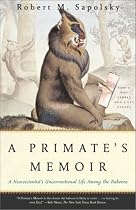
A Primate's Memoir: A Neuroscientist's Unconventional Life Among the Baboons
"I had never planned to become a savanna baboon when I grew up; instead, I had always assumed I would become a mountain gorilla," writes Robert Sapolsky in this witty and riveting chronicle of a scientist's coming-of-age in remote Africa.
An exhilarating account of Sapolsky's twenty-one-year study of a troop of rambunctious baboons in Kenya, A Primate's Memoir interweaves serious scientific observations with wry commentary about the challenges and pleasures of living in the wilds of the Serengeti -- for man and beast alike. Over two decades, Sapolsky survives culinary atrocities, gunpoint encounters, and a surreal kidnapping, while witnessing the encroachment of the tourist mentality on the farthest vestiges of unspoiled Africa. As he conducts unprecedented physiological research on wild primates, he becomes evermore enamored of his subjects -- unique and compelling characters in their own right -- and he returns to them summer after summer, until tragedy finally prevents him.
By turns hilarious and poignant, A Primate's Memoir is a magnum opus from one of our foremost science writers. Amazon.com Review His memoir is, in the main, quite humorous, although Sapolsky flings a few darts along the way at the late activist Dian Fossey--who, he hints, may have indirectly caused the deaths of her beloved mountain gorillas by her unstable, irrational dealings with local people--and at local bureaucrats whose interests did not often coincide with those of Sapolsky's wild charges. It is also full of good information on primates and primatology, a subject whose practitioners, it seems, are constantly fighting to save species and ecosystems. "Every primatologist I know is losing that battle," he writes. "They make me think of someone whose unlikely job would be to collect snowflakes, to rush into a warm room and observe the unique pattern under a microscope before it melts and is never seen again." --Gregory McNamee From Publishers Weekly From Library Journal Great Deal! An All Time Favorite Educational and grippingProduct Details
Editorial Reviews
Robert Sapolsky, the author of Why Zebras Don't Get Ulcers and other popular books on animal and human behavior, decided early in life to become a primatologist, volunteering at the American Museum of Natural History and badgering his high school principal to let him study Swahili to prepare for travel in Africa. When he set out to conduct fieldwork as a young graduate student, though, Sapolsky found that life among a Kenyan baboon troop was markedly different from his earlier bookish studies. Among other things, he confesses, he had to become a master of shooting anesthetic darts into his subjects with a blowgun to take blood samples, a mastery that required him to become "a leering slinky silent quicksilver baboon terror." He also had to learn how to negotiate the complexities of baboon politics, endure the difficulties of life in the bush, and subsist on cases of canned mackerel and beans.
Few would relish a job requiring proficiency with a blowgun as well as a willingness to put up with parching heat, low pay and copious amounts of baboon shit. But for Sapolsky (The Trouble with Testosterone), a Stanford professor and MacArthur grant recipient, it was literally a dream come true. As a boy in New York City, he'd wanted to live in one of the African dioramas at the Museum of Natural History. One week after graduating from Harvard in the mid-1970s, he got his chance: he went to Kenya to study social behavior in baboons. Hilariously unprepared for the challenges of living in the bush, the na ve grad student learned to deal with supply and transportation snafus, army ants and giant cockroaches, safari tourists, dinners of canned spaghetti coated with a mixture of sugar and rancid camel's milk, and surreal government bureaucracies. He developed great fondness for "his" baboons, whose behavior seemed uncannily like that of a bunch of quarrelsome human adolescents, and discovered that their interactions didn't necessarily conform to accepted theories. While Sapolsky's primate observations are always fascinating, his thoughts on Africa and Africans are even more compelling. As funny and irreverent as a good ol' boy regaling his friends with vacation-from-hell stories, Sapolsky can also be disarmingly emotional as in his clear-headed tribute to late gorilla researcher Dian Fossey, and his final chapters, which reveal his rage and impotence as he watched his baboons succumb to a horrific plague. Filled with cynicism and awe, passion and humor, this memoir is both an absorbing account of a young man's growing maturity and a tribute to the continent that, despite its troubles and extremes, held him in its thrall. Agent, Katinka Matson. (Mar. 1) Forecast: Heralded by Oliver Sacks and Edward O. Wilson, and with a well-placed excerpt of this book in Discover magazine, Sapolsky will venture out on a seven-city author tour that should help bring him to the attention of readers interested in animals, Africa, ecology and travel.
Copyright 2001 Reed Business Information, Inc.
Sapolsky (The Trouble with Testosterone), a professor of biology and neurology at Stanford and a research associate with the Institute of Primate Research at the National Museum of Kenya, focuses on his field research with baboons and experiences in Africa in general. He includes all the typical elements of recent popular field biology books (e.g., Margaret Lowman's Life in the Treetops, LJ 5/15/99): how he got his funding, set up camp, and his experiences with the animals he studies, but his hilarious writing style and sense of the absurd are fairly unique in the genre. He alternates tales of the baboons and their interesting social lives with his off-site adventures, which include a surreal kidnapping and an emotional pilgrimage to see mountain gorillas and muse on Dian Fossey's legacy. The book ends poignantly when an epidemic strikes the baboon troop. Recommended for college and public libraries.
- Beth Crim, Prince William P.L., VA
Copyright 2001 Reed Business Information, Inc.Customer Reviews

I needed this book immediately for school. It arrived in time and in good condition. Before ordering I compared prices and this was the best deal. All around everything turned out perfectly.
This book is hard to classify: Is it autobiography? Primatolgy? Travel adventures? Humanist philosophy? Humor? Basically it is all of these and more. It is a real page turner. Sapolsky has a truly marvelous sense of humor that includes knowing how to laugh at himself. I rank it with in the top 10 favorite books I've ever read. Bravo!
This book is an excellent insight into the 20 year life of a biologist who grow as a person while studying baboons and navigating the up and downs of life in Kenya.
Related Links : Product by Amazon or shopping-lifestyle-20 Store

ไม่มีความคิดเห็น:
แสดงความคิดเห็น